Search
Search for projects by name
 MegaETH
Badges
About
MegaETH is a real-time blockchain based on the OP Stack architecture and the hybrid Kailua proof system, targeting sub-millisecond latency and over 100,000 transactions per second.
Badges
About
MegaETH is a real-time blockchain based on the OP Stack architecture and the hybrid Kailua proof system, targeting sub-millisecond latency and over 100,000 transactions per second.
Why is the project listed in others?
Consequence: projects without a data availability bridge fully rely on single entities (the sequencer) to honestly rely available data roots on Ethereum. A malicious sequencer can collude with the proposer to finalize an unavailable state, which can cause loss of funds.
Learn more about the recategorisation here.
Funds can be stolen if
- a contract receives a malicious code upgrade. There is no delay on code upgrades (CRITICAL),
- the source code of unverified contracts contains malicious code (CRITICAL),
- the validity proof cryptography is broken or implemented incorrectly,
- no challenger checks the published stat,
- the proposer routes proof verification through a malicious or faulty verifier by specifying an unsafe route selector.
Funds can be lost if
Funds can be frozen if
MEV can be extracted if
The information in the section might be incomplete or outdated.
The L2BEAT Team is working to research & validate the content before publishing.
This risk is currently under review.
There is no window for users to exit in case of an unwanted regular upgrade since contracts are instantly upgradable.
Only the whitelisted proposers can publish state roots on L1, so in the event of failure the withdrawals are frozen.
Data is posted to EigenDA
Transactions roots are posted onchain and the full data is posted on EigenDA. The sequencer is publishing data to EigenDA v2. Since the DACert Verifier is not used, availability of the data is not verified against EigenDA operators, meaning that the Sequencer can single-handedly publish unavailable commitments. If EigenDA becomes unavailable, the sequencer falls back to Ethereum.
Funds can be lost if the sequencer posts an unavailable transaction root (CRITICAL).
Funds can be lost if the data is not available on the external provider (CRITICAL).
- EigenDA Docs - Overview
- Derivation: Batch submission - OP Mainnet specs
- BatchInbox - address
- OptimismPortal2.sol - source code, depositTransaction function
 EigenDA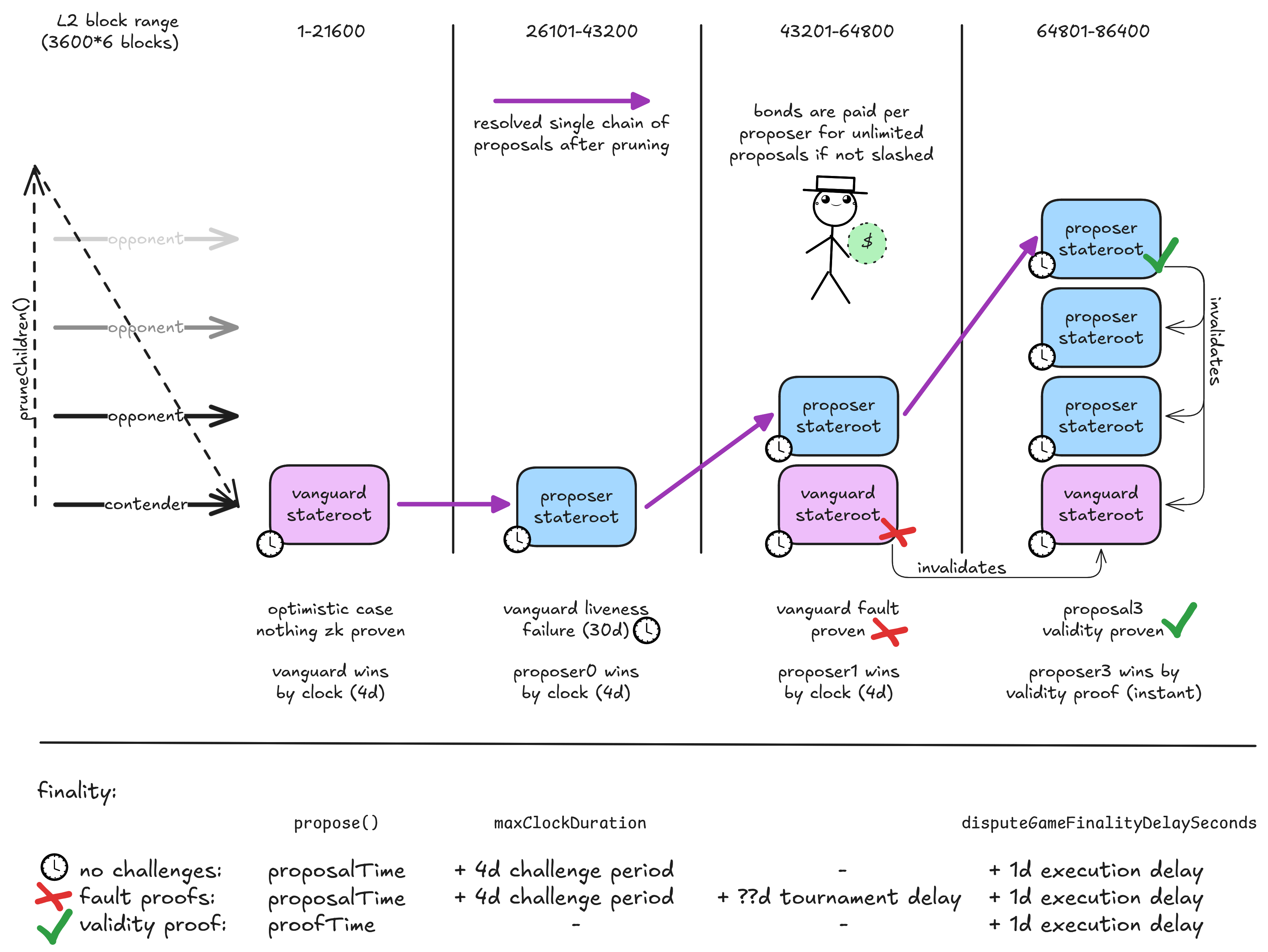
Proposers submit state roots as children of any (possibly unresolved) previous state root proposal, by calling the propose() function in the KailuaTreasury. A parent state root can have multiple conflicting children, composing a tournament. Each proposer requires to lock a bond, currently set to 0.00001 ETH, that can be slashed if any proposal made by them is proven incorrect via a fault proof or a conflicting validity proof. The bond can be withdrawn once the proposer has no more pending proposals that need to be resolved and was not eliminated.
Proposals consist of a state root and a reference to their parent and implicitly challenge any sibling proposals who have the same parent. A proposal asserts that the proposed state root constitutes a valid state transition from the parent’s state root. To offer efficient zk fault proofs, each proposal must include 3600 intermediate state commitments, each spanning 1 L2 blocks.
Proposals target sequential tournament epochs of currently 3600 * 1 L2 blocks. A tournament with a resolved parent tournament, a single child- and no conflicting sibling proposals can be resolved after 7d.
The Vanguard is a privileged actor who can always make the first child proposal on a parent state root. They can, in the worst case, delay each tournament for up to 36558901084y 8mo by not making this first proposal. Sibling proposals made after the Vanguard’s initial one or after the 36558901084y 8mo vanguardAdvantage in each tournament are permissionless.
Any conflicting sibling proposals within a tournament that are made within the 7d challenge period of a proposal they are challenging, delay resolving the tournament until sufficient ZK proofs are published to leave one single tournament survivor.
In the tree of proposed state roots, each parent node can have multiple children. These children are indirectly challenging each other in a tournament, which can only be resolved if but a single child survives. A state root can be resolved if it is the only remaining proposal due to any combination of the following elimination methods:
- the proposal’s challenge period of 7d has ended before a conflicting proposal was made
- the proposal is proven correct with a full validity proof (invalidates all conflicting proposals)
- a conflicting sibling proposal is proven faulty
Proving any of the 3600 intermediate state commitments in a proposal faulty invalidates the entire proposal. Proving a proposal valid invalidates all conflicting siblings. Pruning of a tournament’s children happens strictly chronologically, which guarantees that the first faulty proposal of a given proposer is always pruned first. When pruned, an invalid proposal leads to the elimination of its proposer, which invalidates all their subsequent proposals, slashes their bond, and disallows future proposals by the same address. A slashed bond is transferred to an address chosen by the prover who caused the slashing.
A single remaining child in a tournament can be ‘resolved’ and will be finalized and usable for withdrawals after an execution delay of 3d 12h (time for the Guardian to manually blacklist malicious state roots).
Validity proofs and fault proofs both must be accompanied by a ZK proof that ensures that the new state was derived by correctly applying a series of valid user transactions to the previous state. These proofs are then verified on Ethereum by a smart contract.
The Kailua state validation system is primarily optimistically resolved, so no validity proofs are required in the happy case. But two different zk proofs on unresolved state roots are possible and permissionless: The proveValidity() function proves a state root proposal’s full validity, automatically invalidating all conflicting sibling proposals. proveOutputFault() allows any actor to eliminate a state root proposal for which they can prove that any of the 3600 intermediate state transitions in the proposal are not correct. Both are zk proofs of validity, although one is used as an efficient fault proof to invalidate a single conflicting state transition.
Funds can be stolen if the validity proof cryptography is broken or implemented incorrectly.
Funds can be stolen if no challenger checks the published state
Funds can be stolen if the proposer routes proof verification through a malicious or faulty verifier by specifying an unsafe route selector.
Funds can be frozen if a verifier needed for a given proof is paused by its permissioned owner.
The system has a centralized operator
MEV can be extracted if the operator exploits their centralized position and frontruns user transactions.
Users can force any transaction
Because the state of the system is based on transactions submitted on the underlying host chain and anyone can submit their transactions there it allows the users to circumvent censorship by interacting with the smart contract on the host chain directly.
Regular exits
The user initiates the withdrawal by submitting a regular transaction on this chain. When a state root containing such transaction is settled, the funds become available for withdrawal on L1 after 3d 12h. Withdrawal inclusion can be proven before state root settlement, but a 7d period has to pass before it becomes actionable. The process of state root settlement takes a challenge period of at least 7d to complete. Finally the user submits an L1 transaction to claim the funds. This transaction requires a merkle proof.
Forced messaging
If the user experiences censorship from the operator with regular L2->L1 messaging they can submit their messages directly on L1. The system is then obliged to service this request or halt all messages, including forced withdrawals from L1 and regular messages initiated on L2. Once the force operation is submitted and if the request is serviced, the operation follows the flow of a regular message.
EVM compatible smart contracts are supported
OP stack chains are pursuing the EVM Equivalence model. No changes to smart contracts are required regardless of the language they are written in, i.e. anything deployed on L1 can be deployed on L2.
Ethereum
Roles:
Allowed to pause withdrawals. In op stack systems with a proof system, the Guardian can also blacklist dispute games and set the respected game type (permissioned / permissionless).
Allowed to commit transactions from the current layer to the host chain.
Actors:
A Multisig with 4/7 threshold.
- Can upgrade with no delay
- L1StandardBridge ProxyAdmin
- SystemConfig ProxyAdmin
- L1ERC721Bridge ProxyAdmin
- SuperchainConfig ProxyAdmin
- L1CrossDomainMessenger ProxyAdmin
- OptimismPortal2 ProxyAdmin
- DisputeGameFactory ProxyAdmin
- DelayedWETH ProxyAdmin
- AnchorStateRegistry ProxyAdmin
- OptimismMintableERC20Factory ProxyAdmin
- Can interact with SystemConfig
- Can interact with DelayedWETH
- can pull funds from the contract in case of emergency
- Can interact with AddressManager
- set and change address mappings ProxyAdmin
A Multisig with 4/6 threshold.
- Can interact with MegaPreDepositVaultRefund
- manage all access control roles
- service (execute) refunds from this contract
A Multisig with 4/6 threshold.
- A Sequencer - acting directly
Member of Safe, Safe, Megaeth Multisig, Safe.
- Can interact with RiscZeroVerifierRouter
- add/remove verifiers and the selectors they are mapped to
- A Guardian Safe
Ethereum
The OptimismPortal contract is the main entry point to deposit funds from L1 to L2. It also allows to prove and finalize withdrawals. It specifies which game type can be used for withdrawals, which currently is the KailuaGame.
- Roles:
- admin: ProxyAdmin; ultimately Safe
- This contract stores the following tokens: ETH.
The dispute game factory allows the creation of dispute games, used to propose state roots and eventually challenge them.
- Roles:
- admin: ProxyAdmin; ultimately Safe
This is NOT the shared SuperchainConfig contract of the OP stack Superchain but rather a local fork. It manages the PAUSED_SLOT, a boolean value indicating whether the local chain is paused, and GUARDIAN_SLOT, the address of the guardian which can pause and unpause the system.
- Roles:
- admin: ProxyAdmin; ultimately Safe
- guardian: Safe; ultimately EOA 2
The main entry point to deposit ERC20 tokens from host chain to this chain.
- Roles:
- admin: ProxyAdmin; ultimately Safe
- This contract can store any token.
Used to bridge ERC-721 tokens from host chain to this chain.
- Roles:
- admin: ProxyAdmin; ultimately Safe
Sends messages from host chain to this chain, and relays messages back onto host chain. In the event that a message sent from host chain to this chain is rejected for exceeding this chain’s epoch gas limit, it can be resubmitted via this contract’s replay function.
- Roles:
- admin: ProxyAdmin; ultimately Safe
- Roles:
- owner: Safe
The PreimageOracle contract is used to load the required data from L1 for a dispute game.
Refund escrow designed to hold the funds extracted from the predeposit vault and send them back to the users listed in the vault.
- Roles:
- defaultAdmin: Safe
- executor: Safe
The source code of this contract is not verified on Etherscan.
Predeposit Escrow, not connected to an L2: Users can deposit USDC. The system uses off-chain permit signatures to ensure only KYC’d users can deposit. Withdrawals can only be made by Megaeth Multisig to MegaPreDepositVaultRefund.
- Roles:
- owner: Megaeth Multisig
- permitSigner: EOA 3
- This contract stores the following tokens: USDC.
Implementation of the KailuaGame with type 1337. Based on this implementation, new KailuaGames are created with every new state root proposal.
Contract designed to hold the bonded ETH for each game. It is designed as a wrapper around WETH to allow an owner to function as a backstop if a game would incorrectly distribute funds.
- Roles:
- admin: ProxyAdmin; ultimately Safe
- owner: Safe
A router proxy that routes to verifiers based on selectors. The mapping can be changed by a permissioned owner (0x0A383fF8387CF07315f476D1686E95b1a97adc97).
- Roles:
- owner: EOA 2
- Roles:
- owner: Safe
Same as FaultDisputeGame, but only two permissioned addresses are designated as proposer and challenger.
Entrypoint for state root proposals. Manages bonds (currently 0.00001 ETH) and tournaments for the OP Kailua state validation system, wrapping the OP stack native DisputeGameFactory.
Contains the latest confirmed state root that can be used as a starting point in a dispute game.
- Roles:
- admin: ProxyAdmin; ultimately Safe
The MIPS contract is used to execute the final step of the dispute game which objectively determines the winner of the dispute.
A helper contract that generates OptimismMintableERC20 contracts on the network it’s deployed to. OptimismMintableERC20 is a standard extension of the base ERC20 token contract designed to allow the L1StandardBridge contracts to mint and burn tokens. This makes it possible to use an OptimismMintableERC20 as this chain’s representation of a token on the host chain, or vice-versa.
- Roles:
- admin: ProxyAdmin; ultimately Safe
Value Secured is calculated based on these smart contracts and tokens:
Main entry point for users depositing ERC20 token that do not require custom gateway.
Main entry point for users depositing ETH.
Predeposit escrow for USDC that can only be deposited to after passing KYC and only be withdrawn to a single address.
Multisig currently designated as the ‘Treasury’.
The current deployment carries some associated risks:
Funds can be stolen if a contract receives a malicious code upgrade. There is no delay on code upgrades (CRITICAL).
Funds can be stolen if the source code of unverified contracts contains malicious code (CRITICAL).